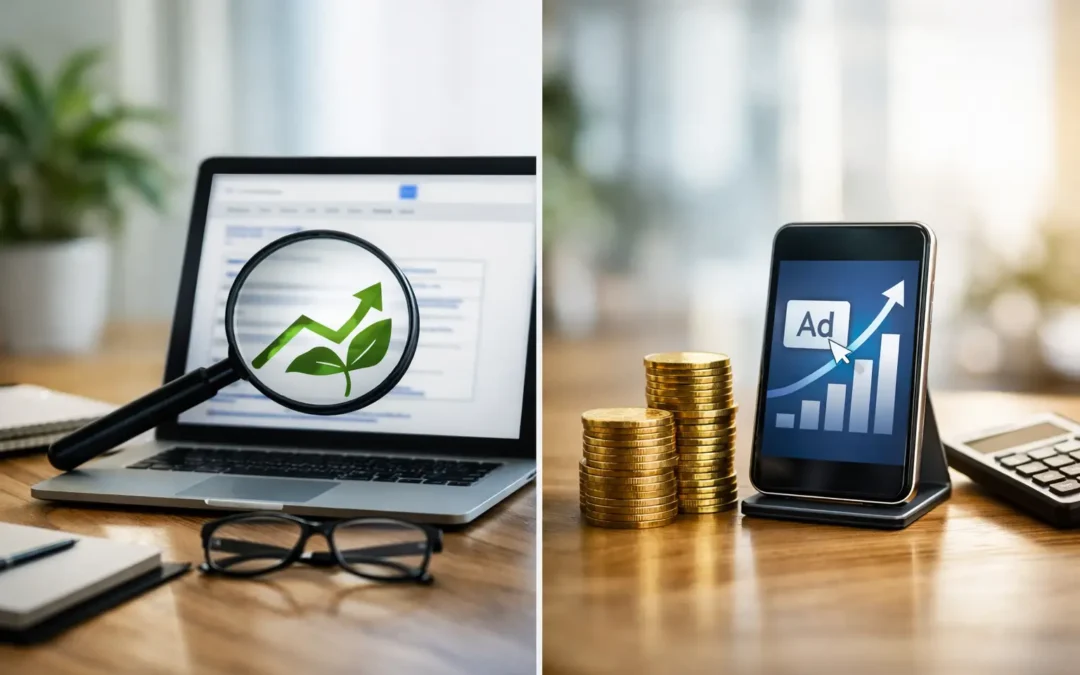
If your pipeline is light this month, the debate around seo vs paid ads stops being theoretical fast. One channel can put your offer in front of buyers within days. The other can keep generating qualified traffic long after a campaign budget is spent. For most businesses, the real question is not which one sounds better. It is which one fits your sales cycle, margin, market competition, and growth timeline.
SEO vs paid ads: the core difference
SEO builds visibility in organic search results over time. You earn traffic by publishing relevant content, improving site structure, strengthening technical performance, and giving search engines enough trust signals to rank your pages.
Paid ads buy visibility immediately. You set a budget, choose an audience or keyword set, launch campaigns, and pay for clicks, impressions, or conversions depending on the platform and objective.
That difference shapes everything else. SEO is an asset-building channel. Paid ads are an acceleration channel. One compounds. The other performs while you keep funding it.
For a business owner or marketing lead, that distinction matters because each channel solves a different problem. If you need leads next week, SEO is rarely fast enough on its own. If you want lower customer acquisition costs six months from now, paid ads alone can become expensive.
When SEO is the stronger investment
SEO makes the most sense when your business has search demand, a clear service offering, and the patience to build momentum. It is especially effective for companies selling products or services people actively research before buying. Think legal services, B2B solutions, renovation firms, clinics, software providers, or ecommerce categories with repeat search volume.
The biggest advantage is compounding return. A well-optimized service page or article can bring in traffic and leads for months or years. Unlike ad clicks, you do not pay every time someone finds you through organic search.
SEO also supports trust. Many buyers skip ads and go straight to organic results because those listings feel more established. If your website ranks well, loads quickly, and answers real customer questions, you are not just attracting traffic. You are earning credibility before the first sales call.
There is also a cost-efficiency argument. SEO usually requires upfront investment in strategy, content, technical fixes, and ongoing optimization. But once rankings improve, the cost per acquisition often becomes more favorable than paid traffic, especially in competitive industries where cost per click keeps rising.
That said, SEO is not magic. It takes time. Results can be uneven early on. Rankings shift. Competitors publish more content. Technical issues can hold back performance. If your website is slow, thin on content, or poorly structured, SEO will take longer and cost more to get right.
When paid ads are the better choice
Paid ads work best when speed matters. If you are launching a new business, promoting a time-sensitive offer, entering a new market, or trying to validate demand quickly, paid traffic gives you immediate data and immediate visibility.
That speed is valuable for more than lead generation. Ads help businesses test messaging, landing pages, offers, and audiences without waiting months for organic traction. You can learn fast which headlines convert, which services get interest, and which segments are worth pursuing.
Paid ads also give you control. SEO depends on algorithms and rankings you do not fully control. Paid campaigns let you set daily budgets, target specific locations, choose devices, define audiences, and direct traffic to focused landing pages built for conversion.
For local campaigns, high-margin services, and offers with strong conversion economics, paid ads can be highly profitable. If one customer is worth thousands in revenue, paying for targeted clicks can make perfect commercial sense.
The downside is obvious. Once the budget pauses, traffic slows or stops. Poor campaign setup can burn spend quickly. Weak landing pages, unclear offers, or broad targeting can turn paid ads into an expensive guessing game.
This is why paid media should never be judged by click volume alone. The real measure is whether it produces qualified leads or sales at a sustainable acquisition cost.
SEO vs paid ads on cost, speed, and sustainability
If you compare seo vs paid ads purely on speed, paid wins. It can start driving traffic almost immediately. SEO is slower because rankings have to be earned.
If you compare them on long-term sustainability, SEO usually wins. Strong organic visibility can keep working even when monthly media spend changes.
If you compare them on control, paid ads have the edge. You can scale, pause, test, and adjust campaigns with precision. SEO gives less direct control because search engines decide where you rank.
If you compare them on efficiency over time, it depends. In some markets, SEO delivers lower acquisition costs once momentum builds. In others, especially niche or urgent purchase categories, paid ads can outperform because the path to conversion is shorter.
The bigger point is this: cost should never be separated from conversion. A low-cost traffic source that does not convert is still inefficient. A higher-cost traffic source that consistently brings in qualified buyers can still be profitable.
The hidden factor: your website
Many businesses compare channels before fixing the actual bottleneck. Traffic is only part of the equation. If your website is slow, confusing, outdated, or weak on messaging, both SEO and paid ads will underperform.
SEO needs a technically sound site with clear structure, relevant content, and pages built around actual search intent. Paid ads need landing pages that match the ad promise, reduce friction, and make conversion easy.
This is where businesses often waste budget. They invest in traffic before investing in the destination. A better website does not just improve rankings. It improves quality score, lowers bounce rate, increases conversion rate, and makes every marketing dollar work harder.
For growth-focused companies, digital performance is rarely one isolated tactic. Brand presentation, page speed, user experience, copy, and conversion flow all affect results. That is why integrated execution tends to outperform fragmented vendor setups.
When a combined strategy makes the most sense
For many businesses, the smartest answer is not choosing one over the other. It is using both with clear roles.
Paid ads can create immediate lead flow while SEO builds long-term visibility. Ads can support new offers, seasonal pushes, and high-intent keywords that are difficult to rank for quickly. SEO can reduce reliance on paid acquisition over time by building a stronger baseline of organic traffic.
There is also a feedback loop between the two. Paid search data can reveal which keywords convert before you invest heavily in SEO content. SEO can uncover questions and search themes that improve ad targeting and landing page messaging.
A combined strategy is especially useful for businesses in competitive markets. It gives you short-term momentum without sacrificing long-term efficiency.
For example, a company launching a new service could run ads to validate demand and generate leads immediately, while building SEO pages that target service-specific and location-based searches. Over time, organic visibility grows and helps offset media spend. That creates a more balanced acquisition model.
How to choose the right channel for your business
Start with your timeline. If you need leads now, paid ads should be part of the plan. If you can invest for compounding returns over the next six to twelve months, SEO deserves serious attention.
Then look at your economics. High customer lifetime value and strong margins usually make paid acquisition easier to justify. Lower-margin businesses often need SEO to keep acquisition costs under control.
Next, assess your market behavior. If customers research heavily before they buy, SEO can become a major growth driver. If purchases are urgent or impulse-driven, paid ads may play a larger role.
Finally, be honest about your foundation. If your website is underperforming, fix that first or at least fix it alongside your traffic strategy. More traffic to a weak site just makes failure happen faster.
A practical decision framework is simple. Use paid ads for speed, testing, and immediate visibility. Use SEO for authority, efficiency, and long-term lead generation. If your business is serious about growth, build toward a system where both channels support each other.
At Rebrand Malaysia, that is often where the best results come from – not from treating SEO and paid media as separate debates, but from aligning them with the website, the offer, and the business goal.
The strongest marketing channel is usually the one that fits your current stage without limiting your next one. Choose the mix that helps you win now and keeps working when growth starts to compound.
SEO vs Paid Ads: Which ROI Winner? Frequently Asked Questions
This FAQ covers the most common questions about SEO vs Paid Ads: Which ROI Winner?. Last Updated: 1 July 2026
What is the core difference between SEO and paid ads?
SEO builds visibility in organic search results over time through content, site structure, and trust signals, earning traffic without paying per click. Paid ads buy immediate visibility by setting a budget, choosing audiences or keywords, and paying for clicks, impressions, or conversions. SEO is an asset-building channel that compounds; paid ads are an acceleration channel that performs only while funded.
- SEO: earn traffic by publishing relevant content and improving site structure
- SEO: search engines decide rankings
- Paid ads: set budget and audience, launch campaigns, pay per action
- Paid ads: immediate visibility and control over targeting
Compare our SEO and paid advertising services
When is SEO the stronger investment?
SEO is the stronger investment when your business has search demand, a clear service offering, and time to build momentum. It works best for companies selling products or services people actively research before buying, such as legal services, B2B solutions, renovation firms, clinics, software providers, or ecommerce categories with repeat search volume.
- Well-optimized pages bring traffic and leads for months or years
- No per-click fees once rankings improve
- Buyers trust organic results more than ads
- Cost per acquisition often becomes more favorable over time
SEO requires upfront investment in strategy, content, and technical fixes. Rankings shift, competitors publish more content, and slow websites take longer to succeed.
Learn about our SEO strategies
When should I choose paid ads over SEO?
Paid ads are better when speed matters: launching a new business, promoting time-sensitive offers, entering new markets, or validating demand quickly. Paid traffic provides immediate data and visibility, letting you test messaging, landing pages, offers, and audiences without waiting months for organic rankings.
- Test headlines, services, and audience segments in days
- Immediate traffic and lead data
- Control over daily budgets, locations, devices, and audiences
- Highly profitable for local campaigns and high-margin services
Once the budget pauses, traffic stops. Poor campaign setup, weak landing pages, or broad targeting can burn budget quickly without producing qualified leads.
Explore our paid advertising solutions
How much does SEO cost compared to paid ads?
SEO typically requires higher upfront investment in strategy, content creation, and technical optimization, but cost per acquisition often becomes more favorable over time, especially in competitive industries. Paid ads have variable costs tied directly to your budget, but once it stops, traffic stops—making long-term costs unpredictable.
- SEO: upfront investment, then lower per-acquisition costs
- Paid ads: continuous spending to maintain traffic
- Competitive markets with high cost-per-click favor SEO long-term
Actual costs depend on your industry, competition level, and desired timeline. A strategic review with your agency can determine the right budget allocation.
Get a cost analysis for your business
Why do buyers prefer organic search results over paid ads?
Many buyers skip ads and go straight to organic results because organic listings feel more established and trustworthy. A website that ranks well, loads quickly, and answers real customer questions earns credibility before the first sales call, making organic visibility a trust signal.
- Organic rankings signal established authority
- Organic results are not labeled as advertisements
- Trust builds before any direct sales interaction
Build trust through SEO ranking
Which channel is faster: SEO or paid ads?
Paid ads are faster, starting to drive traffic almost immediately after launch. SEO is slower because rankings must be earned over time through content, site improvements, and trust-building. For businesses needing leads within days, paid ads are the only viable option alone.
- Paid ads: traffic in days
- SEO: traffic builds over weeks and months
- SEO has uneven results early on
If your sales cycle allows waiting, combining both channels maximizes short-term leads and long-term sustainability.
Discuss timing strategy with our team

- Branding Transformation Example for SME Growth - August 11, 2026
- Corporate Website Content Planning Guide - August 10, 2026
- Website Trust Signals Checklist for More Leads - August 9, 2026